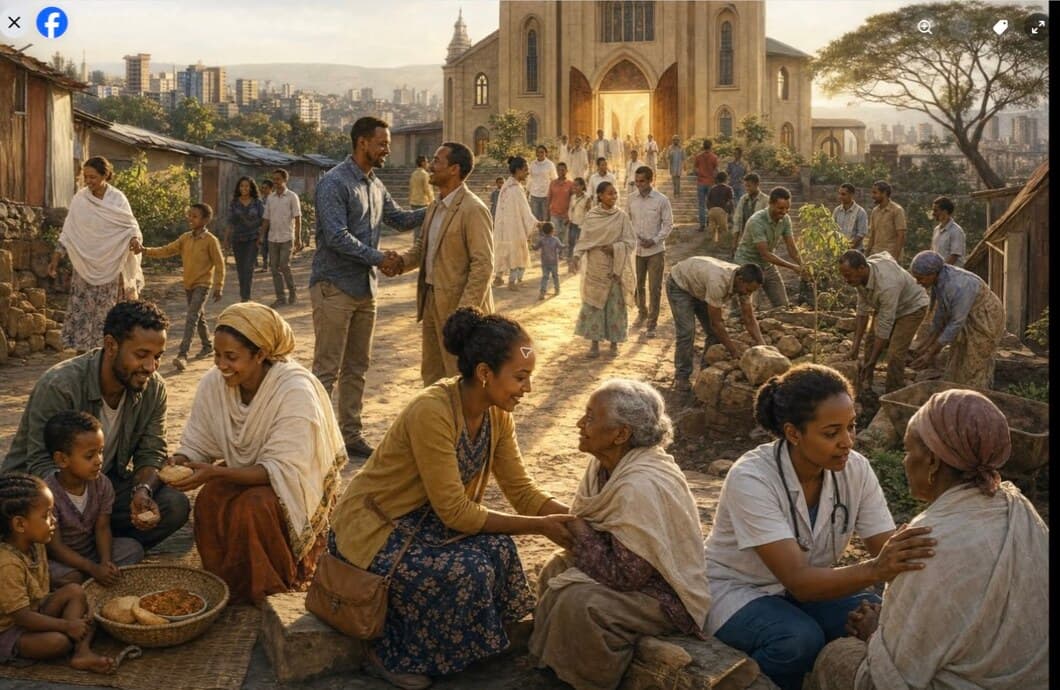
According to global Christian research, there are approximately 2.7 billion Christians and nearly 4.7 million Christian congregations worldwide. Although no dependable global count of church buildings exists, churches can be found in cities, towns, and villages across almost every nation. Christianity also encompasses tens of thousands of denominations, rites, and ecclesiastical traditions.
These impressive numbers should prompt an important question: If there are so many Christians, congregations, church buildings, ministries, and Christian organizations, why is meaningful transformation often so difficult to see—even among believers?
Growth and Transformation
Today, we see magnificent modern church buildings filled with members and visitors. Many local and international churches continue to establish branches, often in the name of outreach and expansion.
According to reports published in 2025, my church, the Ethiopian Evangelical Church Mekane Yesus, has grown to approximately fifteen million members. This is a remarkable record of growth for a church that began as a small national body only a few generations ago.
Similar stories of growth can be told about many other denominations. In numerous parts of the world, churches have experienced undeniable numerical growth and institutional expansion during recent decades. We should recognize this progress and thank God for every person who has heard and received the gospel.
Yet numerical growth alone does not necessarily produce spiritual maturity. Large memberships, beautiful buildings, sophisticated equipment, weekly programs, and impressive religious titles do not automatically create transformed lives.
The Character of the Church
The true influence of the Church must also be measured by the character of its people: their love for one another, care for the vulnerable, faithfulness in marriage and family life, integrity in society, pursuit of justice, and obedience to the teachings of Christ.
The world does not simply need more church buildings. It needs believers whose lives demonstrate the transforming love, truth, humility, holiness, justice, compassion, and unity of Jesus Christ.
It does not merely need sophisticated equipment, beautiful sanctuaries, talented musicians, or crowded worship services on Sunday, Saturday, or any other day. These things may support ministry, but they cannot replace genuine discipleship.
Equipped to Live Beyond the Walls
The church building should be a place where believers are equipped, encouraged, corrected, and prepared to live faithfully outside its walls. We gather for worship and instruction so that we may serve God and our neighbors throughout the rest of the week.
Much of the Christian life is lived from Monday through Saturday—in our homes, workplaces, schools, communities, relationships, and daily responsibilities.
Unfortunately, we sometimes observe the opposite. Churches may compete to demonstrate who has the finest building, the most attractive programs, the best worship service, the largest congregation, or the most celebrated minister. When this happens, ministry can gradually become a public performance or social display rather than a humble expression of service to God and humanity.
Church buildings, programs, technology, and numerical growth are not wrong in themselves. They become problematic when they are treated as the primary evidence of spiritual success.
The Church’s greatest testimony is not the size of its sanctuary, but the quality of life demonstrated by its people.
A Question for Every Believer
If Christianity were faithfully practiced in everyday life, the world in which we live would look very different.
If approximately 2.7 billion Christians cannot meaningfully confront the pain, injustice, loneliness, division, and suffering of our world, then we must ask ourselves: Who will?
Please pause and contemplate this question.